Flagstaff House: Dinner Above Boulder
Perched on Flagstaff Mountain at 6,000 feet, where an extraordinary Chef's tasting menu meets one of the most breathtaking views in Colorado.
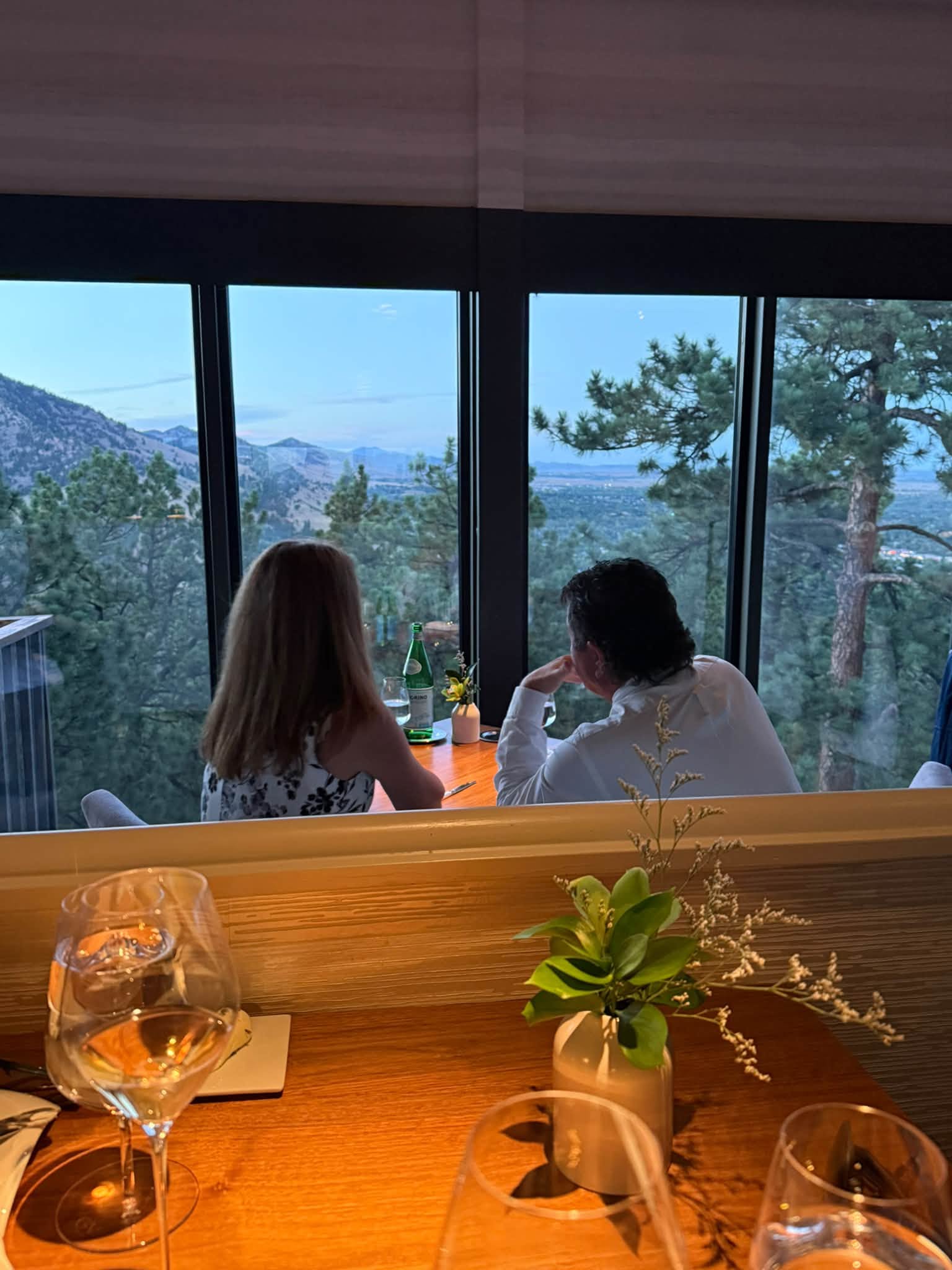
Dining above Boulder at Flagstaff House — panoramic mountain vistas at 6,000 feet.
One of the great pleasures of traveling is discovering new places to eat—and sometimes returning to an old favorite only to discover that it has become something entirely different.
We were in Boulder, Colorado, to see Brandi Carlile live in concert and decided that this trip was the perfect opportunity to revisit Flagstaff House, a restaurant we had enjoyed on a previous visit. Perched on Flagstaff Mountain at roughly 6,000 feet above sea level, Flagstaff House looks down over Boulder from a setting that would be worth the trip even if there were no restaurant there at all. Fortunately, there is—and based on this visit, what is happening in the kitchen may now be every bit as impressive as the view.
Rather than navigate the winding mountain road ourselves, we arranged transportation from the St Julien Hotel & Spa, where we were staying. The ride takes only about fifteen minutes, but it feels like a small journey of its own. You leave downtown Boulder behind and begin climbing, the road curling back and forth through the hills, passing the trails around Chautauqua as glimpses of the city appear between the trees. With each turn, Boulder seems to drop a little farther below you.
Eventually, you arrive at Flagstaff House.
The original structure dates back nearly a century, although the Monette family purchased the property in 1971 and transformed it into the restaurant people know today. More than half a century later, it remains a family-run establishment.
There is still something unmistakably old-school Colorado about the building, but it has been carefully modernized. Stone walls and the bones of a mountain home remain, while expanses of glass, warm wood, contemporary lighting and a beautifully curved bar give the interior a much more current feel. A floor-to-ceiling wine display hints at what is to come, and huge windows make certain that even after you sit down, the mountains and the city remain part of the evening.
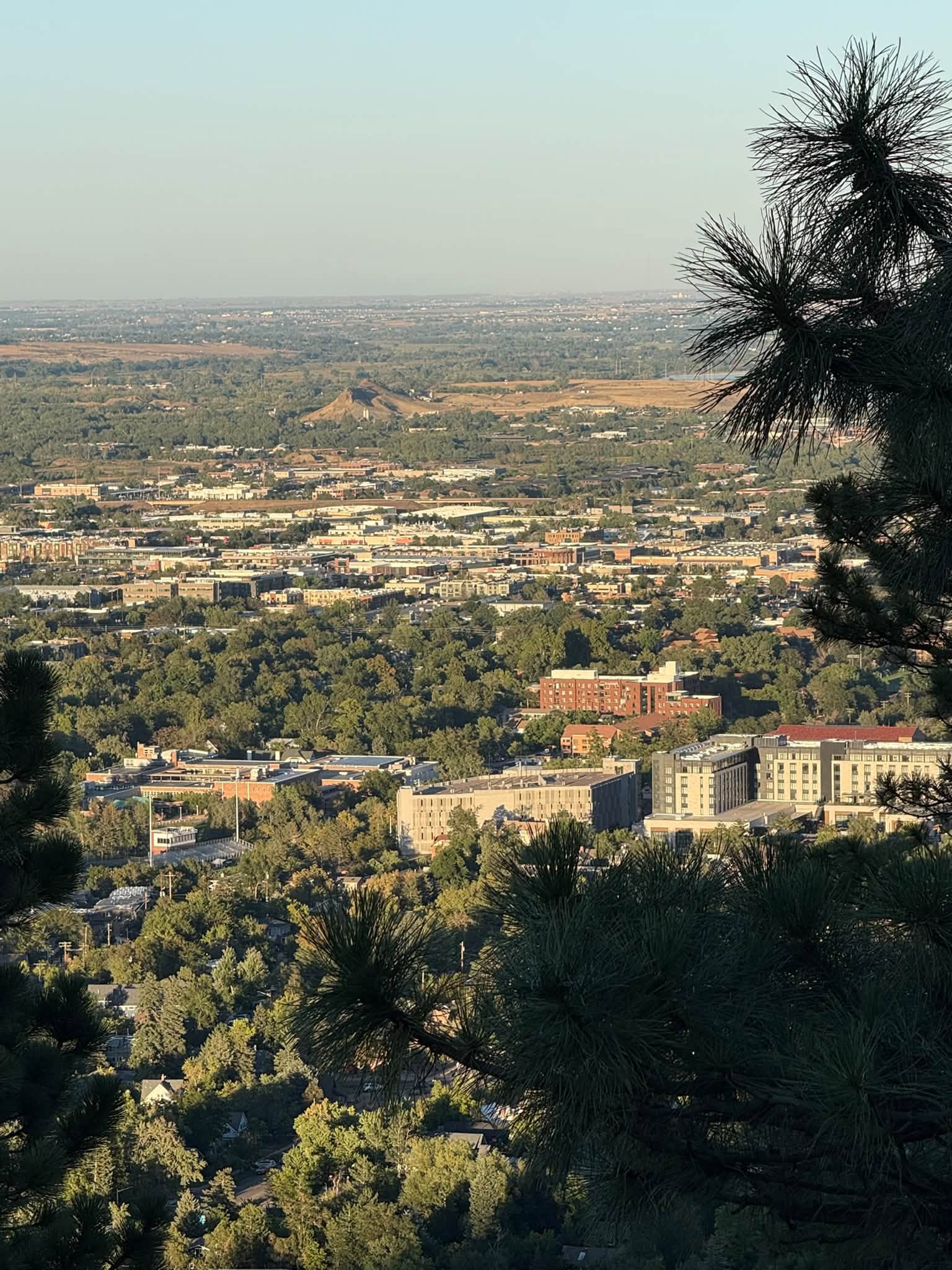
The city of Boulder spread across the valley in extraordinary detail from the patio.
We arrived for our 7 p.m. reservation with plenty of time to wander onto the patio before dinner.
And what a night we had chosen.
The temperature was in the mid-70s, the air was completely dry and there was barely a hint of humidity—a particularly welcome sensation considering that only a day earlier we had left South Florida. No one else was seated on the patio, so for a little while it felt as though the entire mountainside belonged to us.
Below us was Boulder, spread across the valley in extraordinary detail. We could pick out downtown, the University of Colorado campus and its football stadium, and Boulder Reservoir farther in the distance. Turn in another direction and the Flatirons rise behind you, with the Rockies beyond.
We took pictures, wandered the terrace and simply stood there for a while watching the light change.
The blue of the early evening sky softened, the mountains became silhouettes, and one by one the lights of Boulder began appearing below us. By the time darkness settled in, the city had become a field of tiny lights beneath the restaurant. What began as a panoramic daytime view slowly transformed into the backdrop for dinner.
Inside, Flagstaff House has a distinctly romantic feel. Tables are positioned so that the view is never far away, and as the evening grew darker, the lights below seemed almost like part of the dining room.
The service matched the surroundings.
There is a difference between attentive service and intrusive service, and the staff here understands it. People seemed to appear exactly when needed and disappear just as quietly when they were not. Plates arrived with precision. Courses were explained knowledgeably without becoming lectures. The sommelier knew not only the wines but why each had been selected for a particular dish. It was polished without feeling stiff.
That distinction matters, particularly when the evening revolves around a tasting menu.
I will admit that I approach tasting menus with a certain amount of skepticism. Too often they involve microscopic portions, overly complicated presentations and just enough culinary self-importance to make dinner feel like work.
This was a welcome exception.
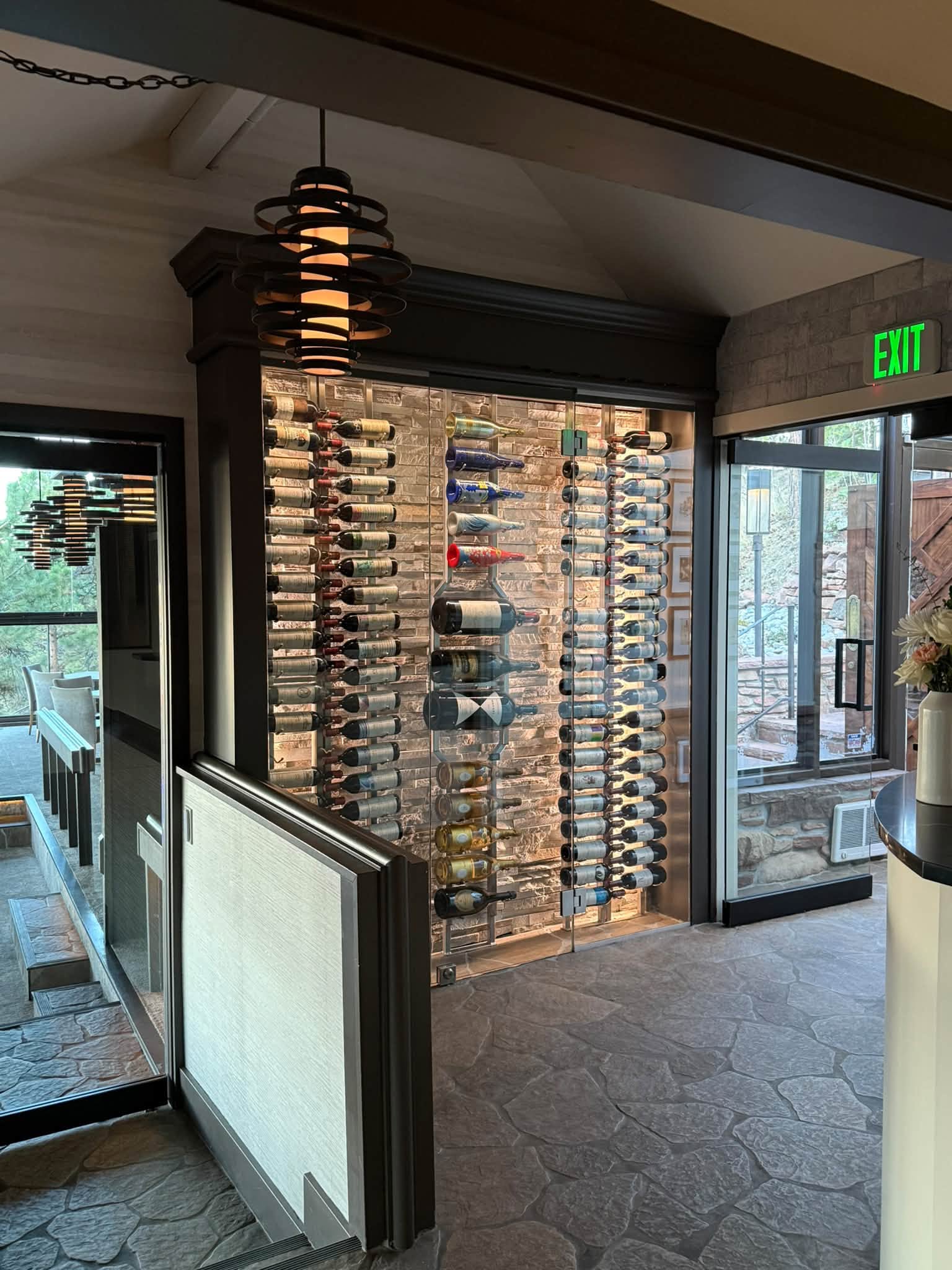
The world-class wine collection at Flagstaff House, showcased against illuminated stone.
The Chef's Menu consists of five courses, with several unexpected tastes appearing along the way. We normally begin an evening out with cocktails, but this time we skipped them altogether and chose the wine pairing. Five courses, five wines—and an opportunity to let the sommelier determine the direction of the evening.
I won't bore you with a bottle-by-bottle inventory. What mattered was how intelligently the wines had been selected. During the evening we moved from Champagne to a dry Australian Riesling, Oregon Pinot Noir, French Burgundy, Beaujolais, California Shiraz and eventually dessert wines. Every wine was served in the appropriate glassware—a detail that may sound minor until you realize how many very good restaurants don't bother.
There was only one real misstep during the entire evening.
An amuse-bouche of egg custard topped with caviar sounded promising, but for us the combination simply didn't work. The custard had an unpleasant bitterness and the caviar pushed the dish too far toward salty. It was the one plate of the night that neither of us particularly enjoyed.
Fortunately, it was also an outlier.
The first official course immediately changed the direction of the meal.
I selected the Costata Romanesco zucchini, paired with chèvre, anise hyssop, agrumato lemon and prosciutto di Parma. Amy chose the Badger Flame beet, accompanied by lemon thyme, Red Rock cheese, sablé and sorrel. Whenever we ordered different dishes, we shared, which effectively allowed us to experience much more of the menu.
The zucchini was delicate and fresh, with the goat cheese supplying richness and the lemon keeping everything bright. Amy's beet preparation went in a different direction—earthier, slightly sweeter and offset by the cheese and crisp sablé. Both were excellent with the Champagne that opened the pairing, and already it was apparent that these were wines chosen to interact with the food rather than simply sit alongside it.
For our second course, we agreed.
We both chose the Cure Farms squash blossom, filled with salmon mousse and served with baby squash, dill and a cherry tomato panzanella. The presentation was beautiful without looking fussed over: the blossom itself still recognizable, the surrounding vegetables giving the plate color and texture. The salmon mousse added richness without overwhelming the delicate squash, while the dry Australian Riesling provided exactly the acidity the dish needed.
By the third course we separated again.
I ordered the Hudson Valley duck, accompanied by Colorado peach, Caña de Cabra goat cheese, brioche and bourbon. Amy selected the Pacific bluefin tuna au poivre, served with eggplant, Rover radish, pepperoncini and a brandy demi-glace.
My duck was paired with an Oregon Pinot Noir, a natural companion for the richness of the meat. Amy's tuna arrived with a fruit-forward French wine from Beaujolais. The tuna was an especially interesting preparation: meaty enough to stand up to the au poivre treatment and the deeper flavors of the demi-glace, but still unmistakably tuna. It was another example of the kitchen taking an idea you think you understand and moving it just far enough in another direction to make you pay attention.
For the final savory portion of the meal, I chose the Texas axis venison, prepared with white miso, Dijon, sprouting cauliflower, black vinegar and chanterelles.
Venison can be unforgiving. It is lean, easily overcooked and sometimes carries a game flavor that overwhelms everything else on the plate.
This did none of those things.
The meat was remarkably tender and clean tasting, without the gaminess I often associate with venison. The accompanying dry Burgundy fit beautifully, giving the dish enough structure without competing with it.
Amy's duck breast, meanwhile, may have been the surprise of the night.
I don't use this description lightly: it was quite possibly the most tender duck breast we have ever eaten. Paired with a California Shiraz, it was rich, deeply flavored and exceptionally well executed. The wine had enough weight to match the duck while still allowing the meat to remain the focus.
By this point, any concern I had about leaving a five-course tasting menu hungry had disappeared completely.
Dessert continued the same level of thoughtfulness.
Amy chose the Manjari chocolate marquise, composed with pistachio, shortbread and orange blossom. Our waiter told us that this was the sixth version of the dessert—the chef had continued revising it because he wanted to get it exactly right.
That little story stayed with me.
Restaurants often talk about attention to detail. This was attention to detail you could actually taste.
The chocolate was paired with an extraordinary Spanish sherry, and the combination demonstrated something that a good wine pairing can do that still surprises me: the wine actually seemed to make the chocolate taste more like chocolate. It intensified it. You take a bite, then a sip, then another bite, and somehow flavors that were already present become more pronounced.
My choice was the huckleberry cheesecake, accompanied by oats, vanilla, yogurt and lemon balm. Rather than looking like a conventional wedge cut from a larger cheesecake, it appeared to have been created as an individual oblong dessert, finished with its own oat crust. Huckleberry sauce supplied the dark fruit flavor while a lemon sorbet brought brightness and acidity. A low-alcohol sparkling red made an inspired pairing—light enough for the end of a long meal, but with enough fruit to meet the huckleberry.
And just when we thought dinner was finished, it wasn't.
A small tiered tray of pastries appeared at the table, a final collection of bites to linger over. Then came one last gesture: two miniature loaves of zucchini bread, packaged for us to take back to the hotel for breakfast the following morning.
It was thoughtful. It was generous. And it somehow summarized the entire evening.
Flagstaff House has long been known for its extraordinary wine program, and after experiencing both the pairings and the knowledge of the staff firsthand, it is easy to understand why.
Our dinner lasted about three hours.
It felt like thirty minutes.
We dine out with friends frequently, and those evenings are some of our favorites. But every once in a while it is nice to sit across the table from the person you travel through life with, put everything else aside and simply reconnect. On this particular night there was nowhere else we needed to be. Outside the windows Boulder glittered below us, the wine kept changing, another plate appeared, and somehow three hours simply disappeared.
Which leaves me with one question.
Why isn't Flagstaff House a Michelin-starred restaurant?
It isn't—at least not yet. Having now eaten there in its current form, I find that surprising.
Michelin stars are Michelin's decision, not mine, but from a diner's perspective this evening checked the boxes I would expect from that level of restaurant: technically accomplished cooking, excellent ingredients, sophisticated wine pairings, precision service, thoughtful pacing and a clear point of view from the kitchen.
Add one of the most remarkable restaurant views in Colorado, and Flagstaff House becomes something even more unusual.
This is unquestionably special-occasion dining, but for us it was worth it.
More importantly, we walked away thinking about when we could come back.
We will definitely return.
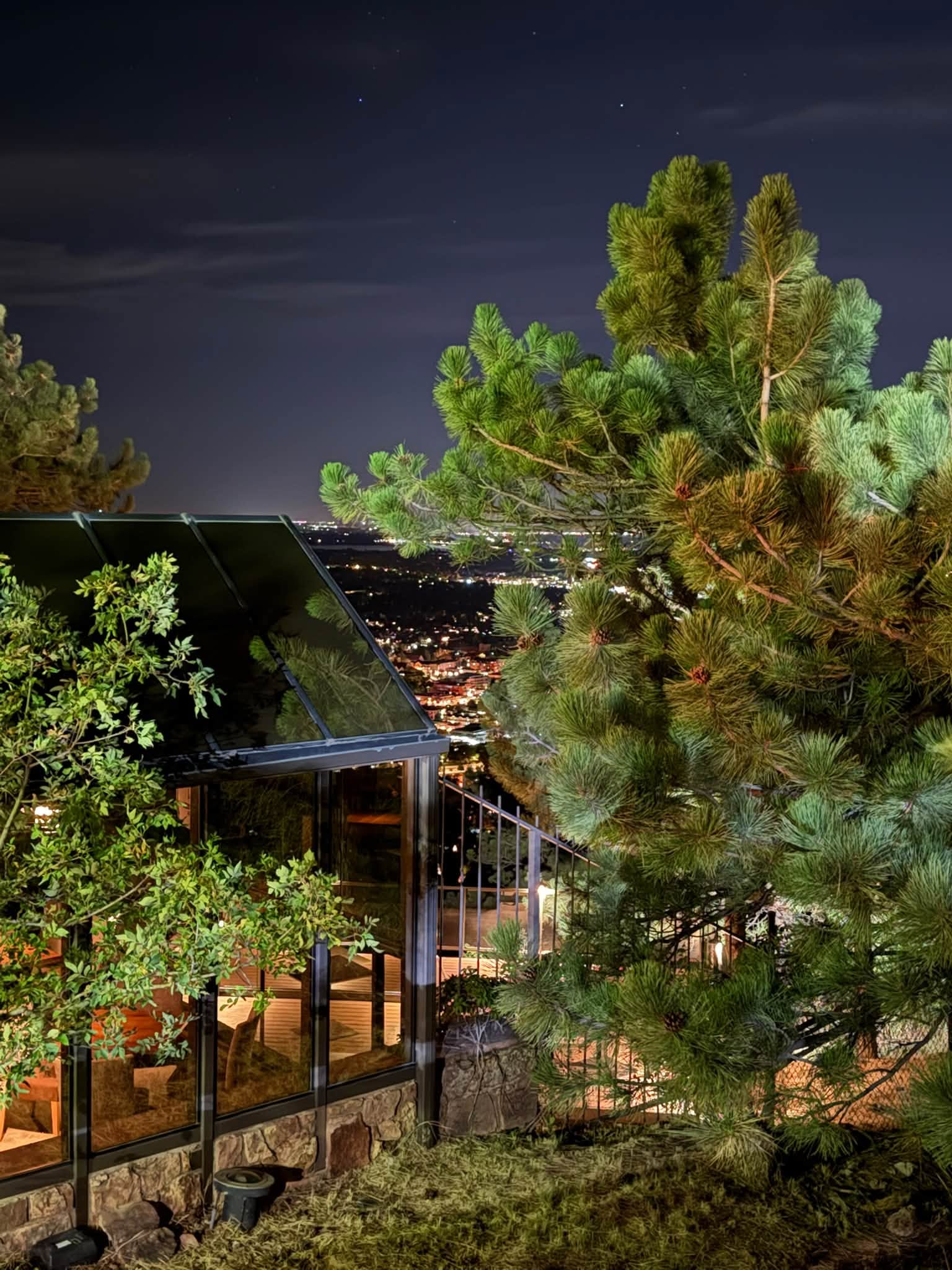
Night settled in and Boulder became a sea of glittering lights beneath the mountain.
Every destination has a story. Every memorable evening leaves an impression. Our hope is simply to share the experiences that make us smile and inspire us to explore.
Enjoy the journey with us! Follow all of our stories at WhiskMeAwayBlog.com — because sometimes the places worth remembering are closer than you think.
— Ira Pearlstine & Amy Smith