You and Me on the Rock
Brandi Carlile at Red Rocks
Under open Colorado skies, towering red sandstone, and distant Denver lights — a concert that belonged entirely to the setting.
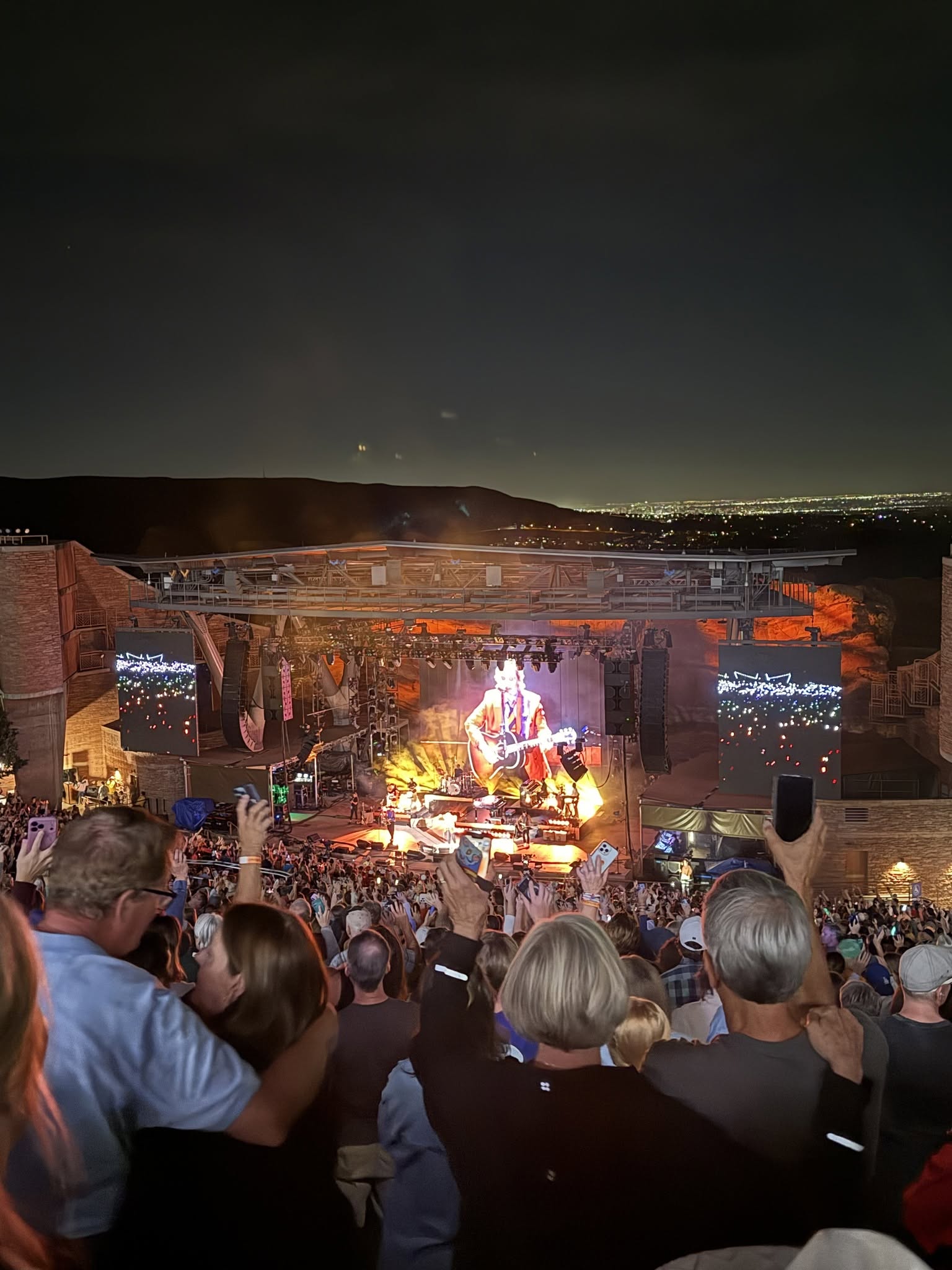
Brandi Carlile live at Red Rocks Amphitheatre — framed by massive sandstone and the glittering lights of Denver beyond.
There are certain concert venues that belong on a music lover’s bucket list. Places where the setting is so much a part of the experience that seeing the same artist somewhere else simply would not be the same.
For us, Red Rocks is one of those places.
This was not our first visit, yet walking into Red Rocks still has an effect that is difficult to reproduce anywhere else. We started in the Lower North Lot and made the climb toward the amphitheater, following the path as enormous red sandstone formations rose around us. In daylight, you can see every layer and fracture in the rock. You walk beside it, beneath it and eventually into it.
Then the amphitheater opens in front of you.
Red Rocks feels enormous and intimate at the same time. There is nothing above you but Colorado sky. Massive rock formations frame either side of the seating, while beyond the stage the land drops away toward the distant lights of Denver. As afternoon becomes evening, the view changes almost minute by minute.
And then there is the sound.
The rock formations that make Red Rocks so visually spectacular also create its extraordinary natural acoustics. Music doesn't seem trapped inside a building or pushed toward you through banks of speakers. It moves through the open space.
Music has been played among these rocks for more than a century. Performances were taking place here as early as 1906. During Franklin Roosevelt's New Deal era, the Civilian Conservation Corps helped transform the natural setting into the amphitheater that ultimately opened in 1941. What is remarkable is how little the setting feels constructed. Nearly everything about the place still directs your attention back to the rocks.
Which made one element of Brandi Carlile's production particularly interesting.
For the first time at one of her Red Rocks shows, a large video screen filled much of the space behind the stage. Brandi talked about having wrestled with the decision because the screen inevitably obscured part of the very landscape everyone had come to see.
I understood the concern.
Red Rocks doesn't need scenery.
But once the show started, the screen worked. Close-up images of Brandi and the band gave the performance an intimacy that would otherwise have been impossible from farther up the amphitheater. The screen changed constantly with the music, while the real scenery remained impossible to ignore on either side.
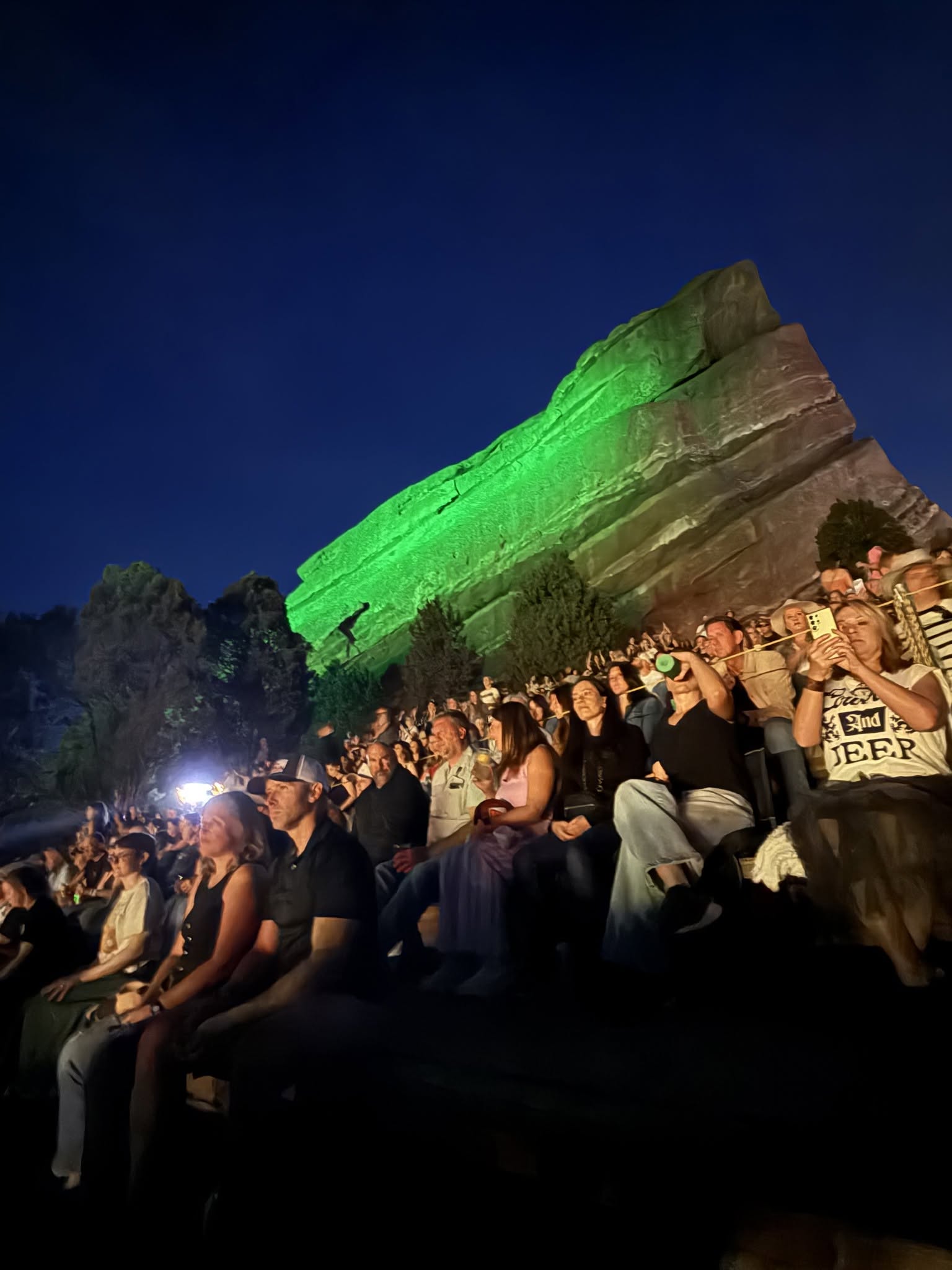
Sandstone monoliths towering over the audience, washed in vibrant color against the Colorado night.
This was my third time seeing Brandi Carlile. All three concerts have been at Red Rocks, which probably says something about how closely I associate her music with this place.
Of the three, this may have been the best.
It was certainly the most energetic.
Brandi performed for more than two hours without a break, drawing from nearly 25 years of music while mixing in songs from her newest album, Returning to Myself, which for me may be her strongest work yet.
But this never felt like an artist moving methodically through a predetermined tour setlist.
Quite the opposite.
Brandi became increasingly conversational with the audience as the evening went on. She joked, talked directly with people in the seats and departed from the expected running order. At one point, she actually began asking members of the audience what they wanted to hear.
Think about that for a moment.
Thousands of people are packed into one of the most famous concert venues in the world, watching one of the biggest performers in American music, and she is taking requests.
It changed the feel of the concert. The scale remained enormous, but the interaction didn't.
Early in the show came the song that could almost have been written for the setting.
Song number three was You and Me on the Rock.
The title hardly needed interpretation.
We were sitting there together as the last blue daylight disappeared over the amphitheater. Red sandstone towered beside us. Denver was beginning to glow beyond the stage. A few stars appeared overhead.
You and me.
On the rock.
Sometimes the obvious works perfectly.
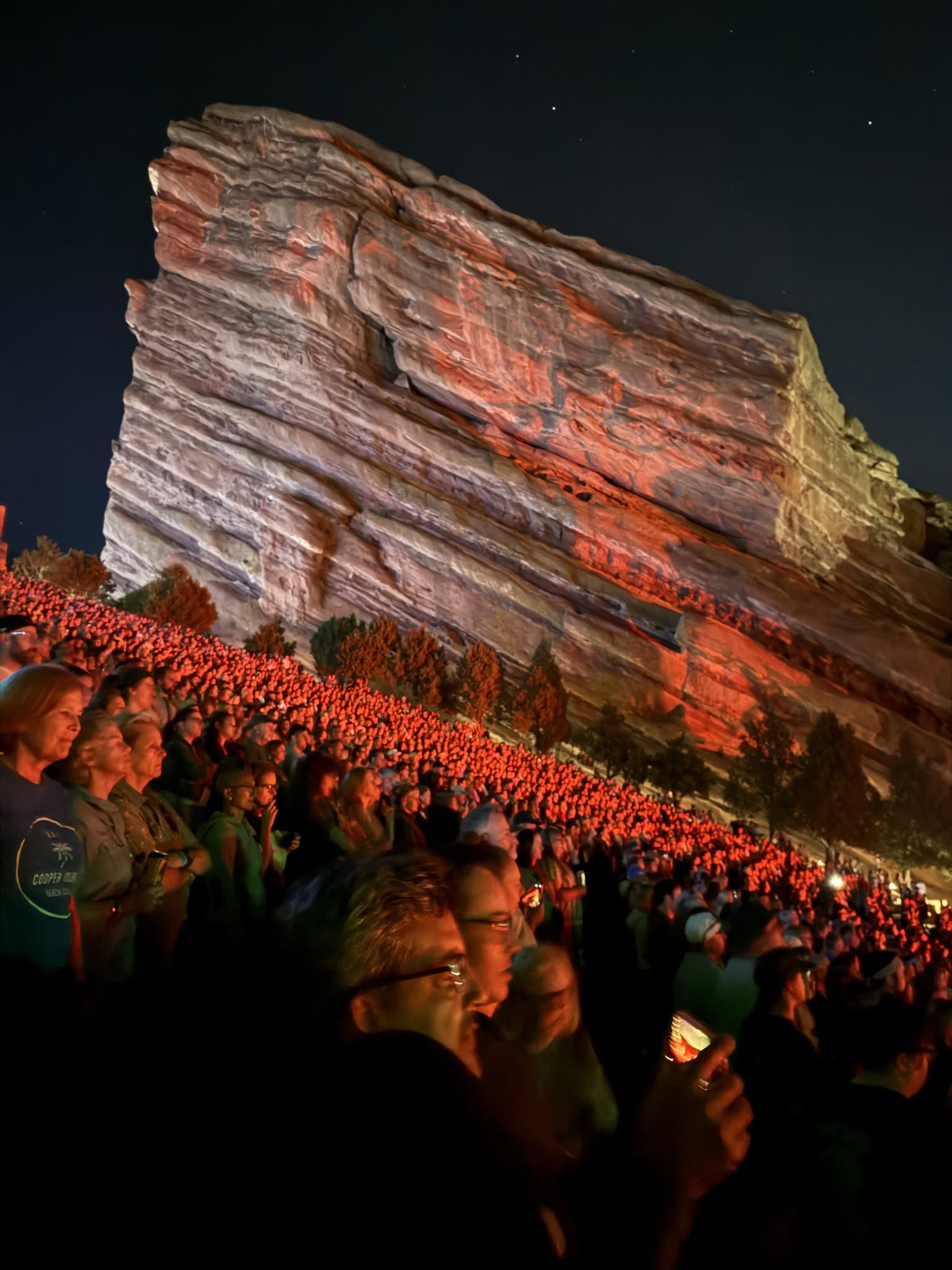
The iconic sandstone glowing in brilliant red above thousands of voices singing beneath the stars.
As powerful as Brandi is as a solo performer, much of what makes her live sound so distinctive comes from the musicians around her.
Tim and Phil Hanseroth, the identical twins who have been beside her virtually from the beginning, remain at the core of that sound. Tim on guitar, Phil on bass, both contributing the close vocal harmonies that have become inseparable from Brandi's music. The relationship goes beyond the stage as well; Phil is married to Brandi's sister, Tiffany.
They don't feel like musicians hired for a tour. They feel like part of the architecture of the music.
Then there were SistaStrings, sisters Chauntee and Monique Ross, whose violin, cello and vocals added another dimension entirely. At Red Rocks, the strings were particularly striking. You could hear the violin rise above the band and the cello fill the space beneath it without either disappearing into the enormous open-air setting.
The rest of the band moved just as comfortably between quieter arrangements and full rock-and-roll force.
And Red Rocks gave all of it room.
By then the sky had gone completely dark.
Looking toward the stage, Denver spread across the horizon as a field of tiny lights. Looking sideways, the sandstone walls were being washed in changing colors — green at one moment, deep red at another. Above them was a remarkably clear Colorado night, stars visible over thousands of people, amplifiers, video screens and stage lights.
There were moments when it was difficult to decide where to look.
- At Brandi.
- At the band.
- At the enormous illuminated rock beside us.
- Or past the stage toward the city.
One of the most memorable scenes came when thousands of people raised their phones, tiny white lights filling the amphitheater beneath a rock face glowing brilliant red. It was an image that probably could not exist anywhere else.
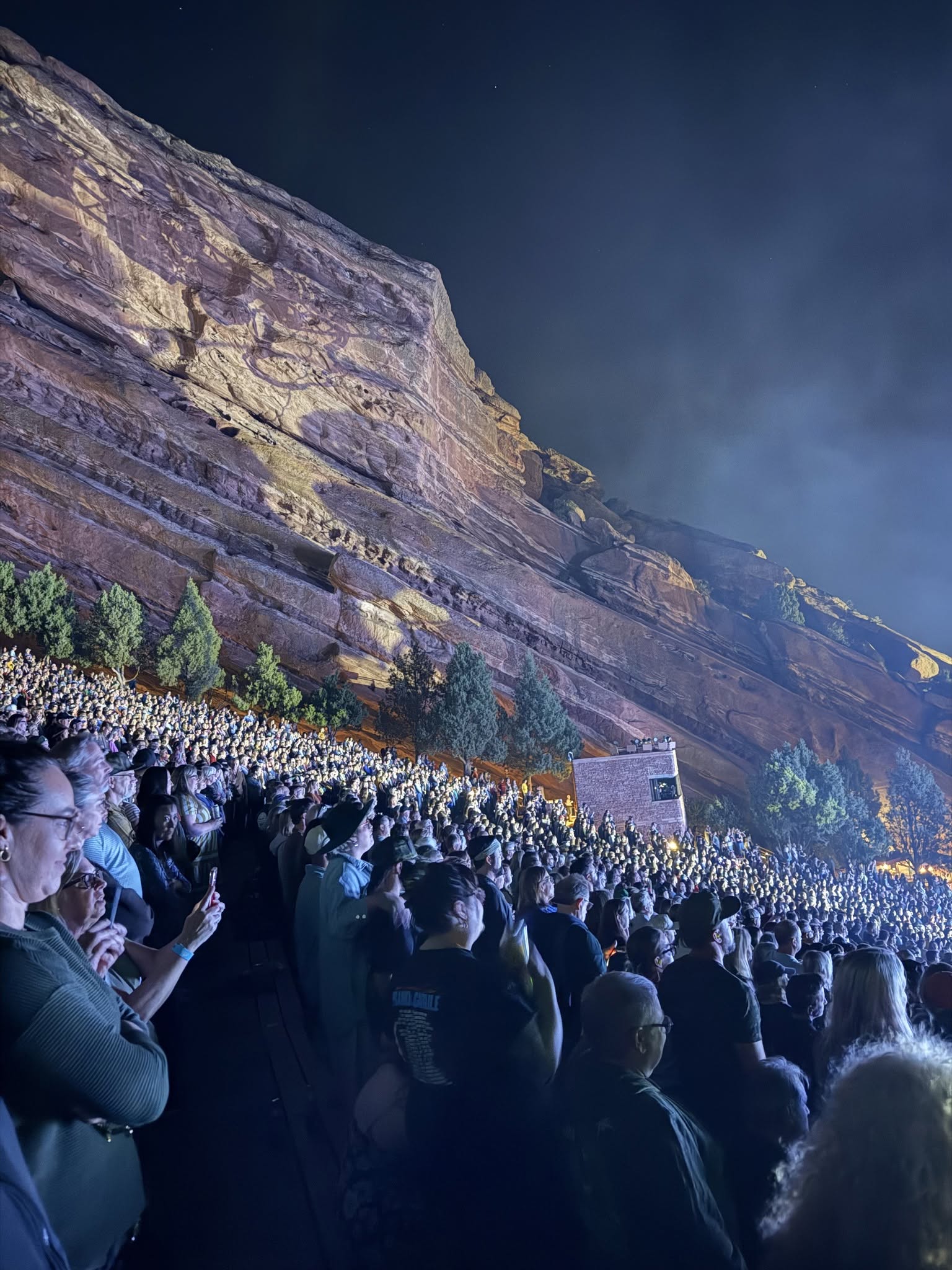
Thousands packed into the amphitheater, sharing a night that felt both colossal and remarkably intimate.
And then Brandi still had one surprise left.
For the encore, she brought out Alanis Morissette.
The reaction was immediate.
Together they performed Uninvited, turning what had already been an exceptional concert into something completely unexpected. It was the kind of guest appearance that produces a split second of disbelief before the entire audience realizes at essentially the same moment what is happening.
By the time the final songs ended, more than two hours had passed without ever feeling long.
We had arrived in daylight.
We had walked up through the sandstone formations while the sun was still hitting the rocks. We watched the amphitheater fill. We watched the blue sky turn black. We watched Denver emerge in the distance as thousands of lights. And we listened as Brandi Carlile moved between songs written across nearly a quarter-century of her career.
Three Brandi Carlile concerts.
All three at Red Rocks.
And somehow this one felt different.
Maybe it was the energy. Maybe it was the band. Maybe it was the spontaneity and the requests from the audience. Maybe it was SistaStrings, the surprise appearance by Alanis Morissette, or simply catching Red Rocks on one of those crystal-clear Colorado nights when the stars, the city and the illuminated sandstone all seemed visible at once.
Or maybe it was simpler than that.
For one night in Colorado, we were exactly where the song said we should be.
You and me on the rock.
Every destination has a story. Every memorable evening leaves an impression. Our hope is simply to share the experiences that make us smile and inspire us to explore. Enjoy the journey with us! Follow and subscribe to whiskmeawayblog.com — because sometimes the places worth remembering are closer than you think
— Ira Pearlstine and Amy Smith